
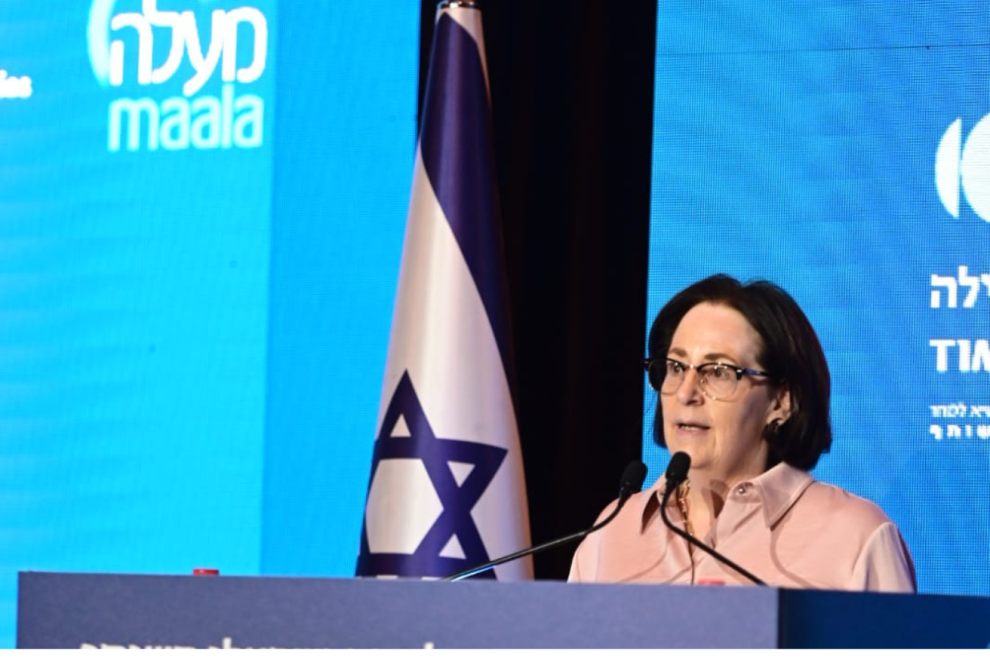
Together with Jewish Federations of North America, Boston's Federation, Combined Jewish Philanthropies, and other partners, Israel’s President Isaac Herzog convened over 1,400 nonprofit leaders, social entrepreneurs, and community organizers on May 13 at the President's Conference for a Shared Israeli Future in Jerusalem.
Opening the gathering, Herzog emphasized the need for dialogue and compromise on divisive national issues.
"When there are fuel fumes in the air and we are entering elections, the answer is here in this tremendous movement of ‘Time to Talk.’ A movement that comes and says: I am coming to talk to you. I want to hear your pain. I want to understand that there is a tremendous social evolution in Israeli society," he said.
"We must also remember that we have brothers and sisters across the ocean, the Jewish people, who are going through a hell of unimaginable antisemitism, who look to us with worry and anxiety and want us to be an anchor of stability and responsibility. They want to hear us, and they want to know they have our backing," he added.
The conference featured remarks by Rebecca Caspi, Senior Vice President, Jewish Federations of North America, who underscored the strategic importance of the partnership between Israel and North American Jewish communities for Israel’s recovery and long‑term resilience.
“Since the beginning of the war, we worked to respond immediately to the needs of Israeli society," Caspi said. "Today, through the Rebuild Israel program, we are continuing to connect Israel with Jewish communities in North America and build partnerships to create a better shared future.”
Rebuild Israel, a coordinated, cross-Federation effort to help Israeli society not just recover but flourish in the aftermath of our historic Emergency campaign, spans everything from trauma healing programs and mental health campaigns to agricultural restoration, small business loans, support for reservists and their families, and volunteer deployment across the country.
"The goal is not to return to what was, but to build something stronger," she continued. "Israel's shared future will not only be built in Jerusalem, Sderot, or Kiryat Shmona, but alongside Jewish communities in New York, Toronto, Miami, and Los Angeles. The partnership between Israel and North American Jewry is a strategic asset that goes far beyond economic support."
Rabbi Marc Baker, President and CEO of CJP, spoke at the closing plenary and delivered a deeply personal and intellectual call for renewed Jewish peoplehood, arguing that October 7 awakened not only vulnerability, but a shared responsibility to choose unity, dialogue, and a common future between Israel and global Jewry.
"To see Americans and Israelis connect with one another is like witnessing the spark of Jewish peoplehood — the realization that we are family, and the awakening of something deep within that binds us together," said Marc Baker, President and CEO of CJP. "We do not spend enough time listening and encountering one another with curiosity, and we do not truly speak with one another — not the polite conversations Americans are accustomed to, nor the direct sarcasm of Israelis — but soul-level conversations, real and deep dialogue, and the willingness to engage in the honest and difficult conversations that true friends and family members must face."
Herzog also addressed rising antisemitism faced by Jewish communities worldwide, stressing that Jews outside Israel were looking to Israel as a source of stability, responsibility, and moral support. He warned against escalating rhetoric as the country moved closer to elections, calling instead for lowering tensions and expanding internal dialogue through initiatives like his “Time to Talk” framework aimed at acknowledging differing experiences and social change within Israeli society.
In a conversation with First Lady Michal Herzog, actress Gal Gadot described the growing personal and public challenges of being Israeli abroad, citing fear, anger and frustration amid social‑media polarization, and said broader exposure to dialogue initiatives like the conference could help convey a fuller picture of Israeli society to the world.
0Comments
Add CommentPlease login to leave a comment