
‘Survival seeped through me’: Honored at the California State Capitol for Yom HaShoah, Holocaust Remembrance Day.
By Solvej Schou
A year ago, in April 2025, I was honored as the descendant of Holocaust survivors by Democratic State Senator Susan Rubio at the California State Capitol. This is the story of that moment.
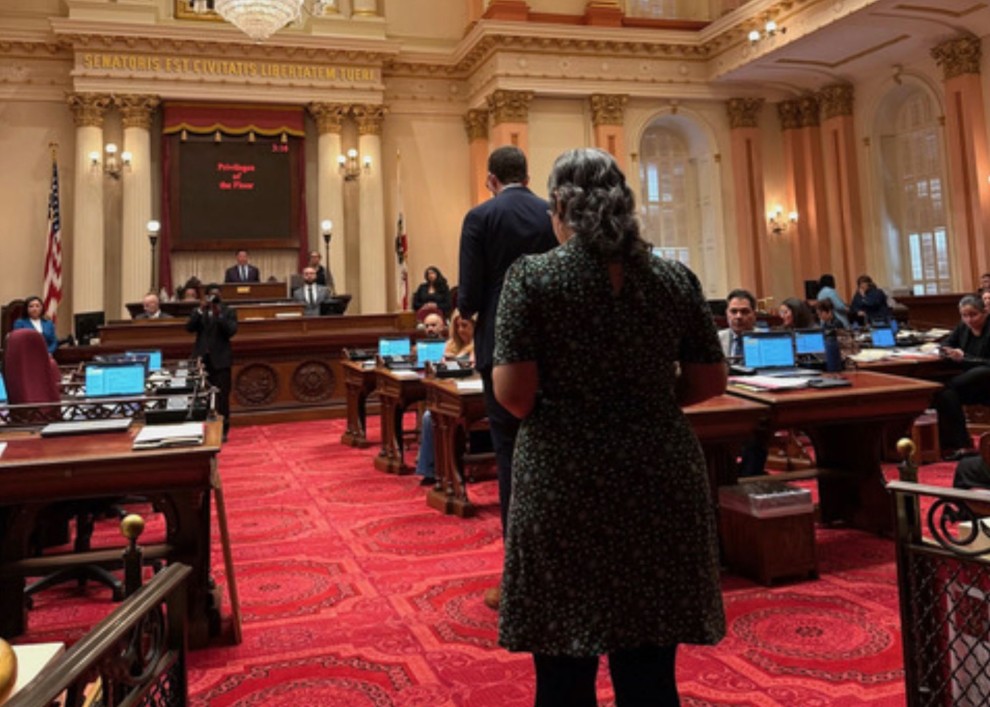
In the California State Capitol’s Senate Chamber, with its red-patterned rug and high beige walls—chandeliers dangling above—I gripped the hand of George Elbaum to the left of me and Eva Brettler to the right.
Both Holocaust survivors in their 90s were there, like me, to be honored by members of the California Legislative Jewish Caucus for Yom HaShoah, Holocaust Remembrance Day.
Born and raised in Los Angeles and based in the San Gabriel Valley, I had never been to Sacramento, much less to the State Capitol. The Jewish Federation of the Greater San Gabriel and Pomona Valleys had recommended me as an honoree to State Senator Rubio’s office.
As the Jewish American grandchild of Holocaust survivors, I felt the power, that day, of George and Eva’s survival seep through me. The heat and dampness of their palms. The rise and fall of their breath. It is difficult to describe. I was flanked by survival. I was and am the product of Jewish survival.
Each of us wore yellow roses pinned to our clothes. My outfit was a black high-necked dress with small blue and green flowers, paired with a white acrylic Star of David necklace and blue Star of David earrings, decorated with a glittering evil eye, for protection. George wore a black suit and a dark blue tie. Eva wore all black—shirt, sweater, skirt—with a long gold necklace.
We sat at the back of the Senate Chamber on red velvet seats, with two other Holocaust survivors seated behind us.
One by one, during a roll call, each member of the California State Senate—both Democrats and Republicans, with three State Senate members absent—raised their hand and voted “aye” on California bill SCR46, proclaiming April 24, 2025, as California Holocaust Memorial Day.
Continuing to clasp George and Eva’s hands, I started to weep.
At one point, George leaned towards me and whispered, “Can you imagine this happening in Germany in the 1940s?”
The story of Holocaust survival is a story of Jewish survival.
With only 0.2% of the world’s population Jewish, and only 2.4% of the U.S. population Jewish, I have always been a proud Jewish American shaped by that history of survival, deep in my soul.
My Jewish Polish late grandma and late zaide (Yiddish for grandpa) miraculously survived the Shoah, the Holocaust—during which 6 million Jews were persecuted and killed by the Nazis—and endured deep trauma and loss, from the murder of their 6-year-old son to the massacre of their siblings, cousins, nephews, and nieces.
My grandma was put out three times to be shot and chosen three times to be sent to the crematorium at the Polish forced labor ammunition camp where she was imprisoned. When the camp was liberated in 1945, she had no shoes or clothes and could hardly walk.
Born in a displaced persons camp in Germany after World War II, my late mom came with my grandparents as refugees and immigrants to the United States in 1949. When they arrived, they had just two bags of belongings. My mom was three months old. They first arrived in New York and then settled in Los Angeles’s Boyle Heights neighborhood.
My late grandma’s strength as a survivor poured through everything she said and did, from her fiercely tight hugs to her Yiddish-accented voice telling me, when I was a kid and teenager, to savor health and independence.
George was a year old, living in Warsaw, Poland, when Nazi Germany invaded in 1939. Over the span of three years, being forced to live in the Warsaw Ghetto, 10 members of his family perished, and George and his mom survived.
After his mom smuggled them out in 1942, George lived in hiding with Polish Catholic families, and his mother worked as a domestic laborer. At age 11, in 1949, he and his mom came to the U.S. After decades of silence about the Holocaust, he wrote the 2010 book “Neither Yesterdays Nor Tomorrows: Vignettes of a Holocaust Childhood,” and speaks at schools across the country.
Born in Romania in 1936, Eva was taken, with her mom, to Germany’s Ravensbrück concentration camp when the Nazis invaded Hungary in 1944. Her mom did not survive the journey, and Eva was later sent to the German concentration camp Bergen-Belsen. After World War II, she reunited with her father. Amid growing antisemitism in Hungary, she escaped to Vienna, then to the U.S., and California. Her father and stepbrother came three months later.
That day, for Holocaust Remembrance Day, in the California Senate Chamber, flanked by George and Eva, I could feel my heart thumping in my chest, thinking of these stories of trauma and survival.
Then, when my name, as an honoree, was called by State Senator Scott Weiner—filling in for State Senator Rubio, who was unable that day to make the ceremony, but who I met and spent an amazing time with directly after, at the Capitol—I joined him on the Senate Chamber floor, with a black and white photo of my grandma.
I held up the photo to the State Senators seated in either of the chambers, feeling tears ready to burst out of me.
In the photo, my grandma stares straight at the camera—a slight smile on her lips—and sits on a motorcycle, wearing knee-high black boots.
It’s the only photo I have of her in Europe, before she came to the U.S.
“On behalf of Senator Rubio, I am proud to introduce her honoree Solvej Schou,” said Senator Weiner on the Chamber floor, before giving me a Yom HaShoah ceremony plaque bearing my name.
“Solvej is a San Gabriel Valley based writer and musician, and the proud Jewish American granddaughter of Holocaust survivors,” he said. “Her late grandmother Ethel, a Jewish Polish Holocaust survivor, came as a refugee to the United States in 1949 with Solvej’s grandfather and then 3-month-old mother, who was born in a displaced persons camp.”
“Unfortunately, other members of her family did not survive the Nazi atrocities of World War II. Her grandmother was the strongest person she’d ever known. She brings to the Senate floor today a portrait of her late grandmother, which she is holding.”
“Solvej is a testament to her grandmother’s strength, and her legacy lives on particularly in her recent song ‘This Is My Jewish Heart,’ which is in part about her grandmother being a Holocaust survivor, and about Jewish resilience.”
“Please join me in welcoming and honoring Solvej Schou.”